Beyond the equipment commonly used in biology and cell culture, the GSBMS has experimental resources specifically adapted to studying the effects of gravity and its variations on biological systems.
This equipment makes it possible to reproduce, within the limits of what is achievable on Earth, certain constraints encountered during space missions and to prepare experiments before they are flown.
The combination of multidisciplinary scientific expertise, technical know-how and experience of the constraints of space missions is one of the GSBMS’s distinctive features.
Clinostats
Clinostats are devices that make it possible to study, on Earth, the effects linked to the absence or reduction of the gravitational stimulus. Their principle relies on the controlled rotation of a biological sample, so as to continuously change its orientation relative to the gravity vector.
In a horizontal-rotation clinostat, the gravity vector thus progressively sweeps 360° around the sample with each revolution. This rotation reduces the gravitational stimulus perceived by the biological system and simulates certain effects observed under microgravity conditions.
The GSBMS has several types of clinostats, suited to different biological models and experimental conditions.
Fast clinostat
The fast clinostat allows a rotation of between 20 and 200 revolutions per minute (rpm).
It is particularly suited to experiments requiring high-speed rotation and makes it possible to work with up to 20 cultures simultaneously.
Slow horizontal clinostat
The slow horizontal clinostat operates at rotation speeds of between 0 and 5 rpm.
This range of speeds makes it possible to adapt the experimental conditions to different types of samples and biological models.
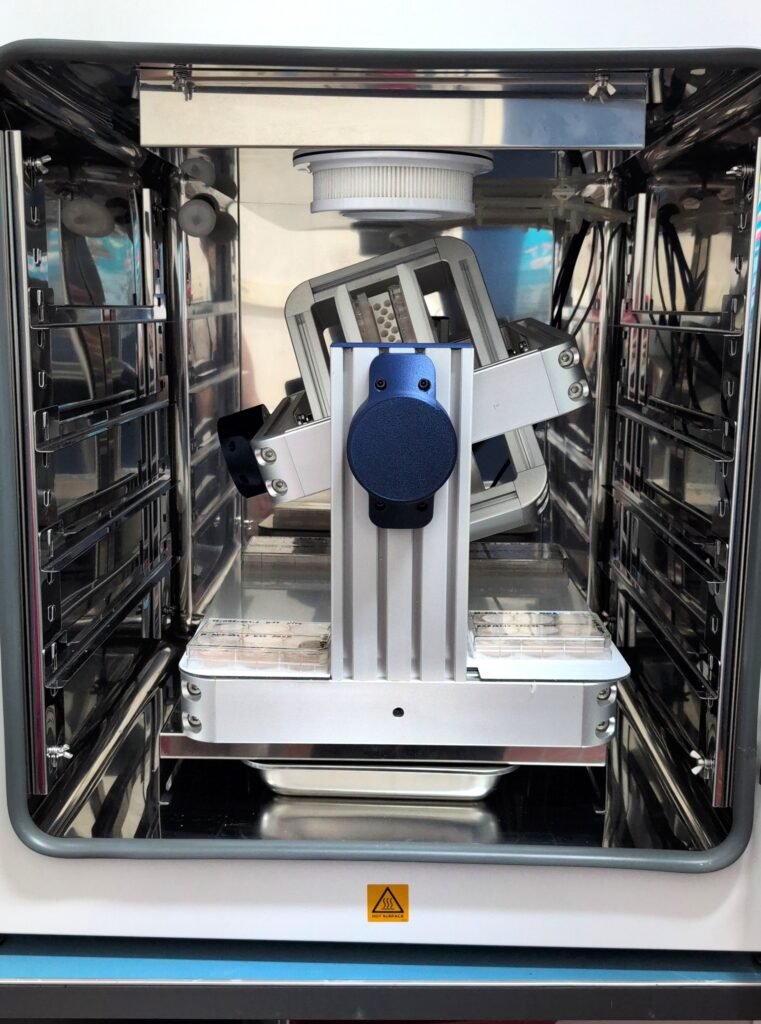
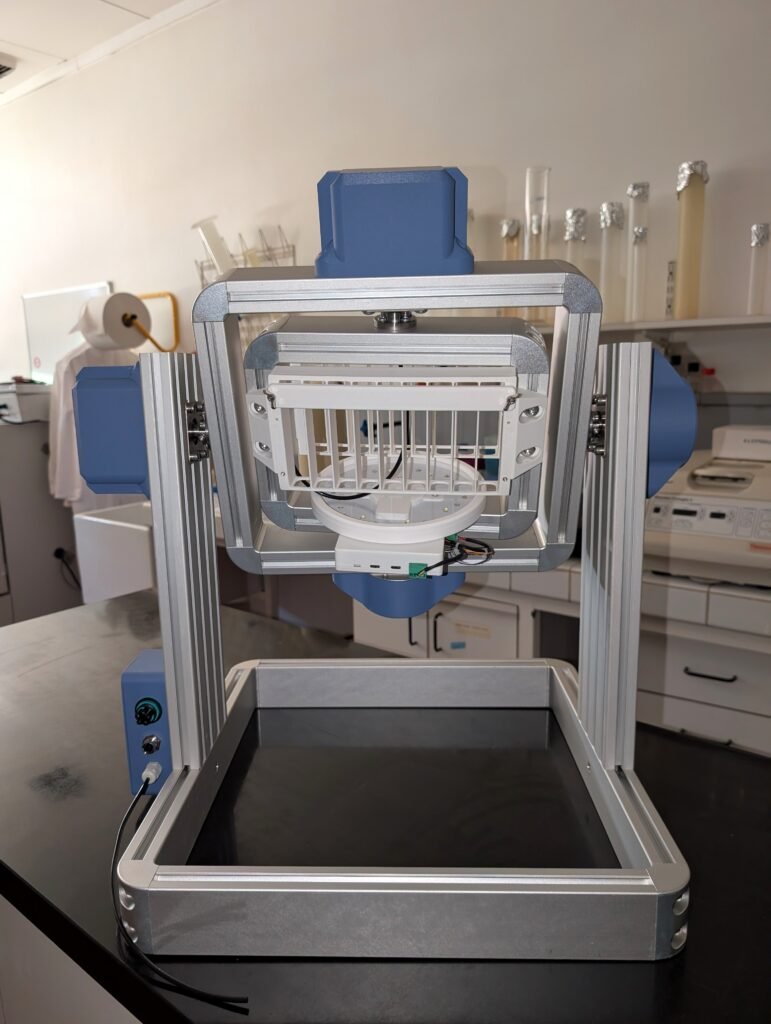
3-D Clinostat — Random Positioning Machine (RPM)
The Random Positioning Machine (RPM) enables the rotation of samples in the different planes of space thanks to two axes of rotation. The successive orientations of the sample continuously reduce the directional effect of gravity, thereby mimicking certain conditions associated with microgravity.
This equipment can also be used in different configurations:
2-D clinostat, with a rotation speed of between 0.1 and 20 rpm;
centrifuge, generating an acceleration of between 1 and 1.1 g.
OIUS clinostat
The OIUS clinostat completes this range of equipment dedicated to studying the effects of gravity on biological systems. It makes it possible to carry out microgravity simulation experiments under controlled and reproducible conditions.
The diversity of devices available within the GSBMS thus makes it possible to adapt the simulation conditions to the biological models, scientific objectives and experimental protocols being studied.